Some thoughts on upright bass method books
I didn't even know what the heck an Etude book was until I got to
college at Indiana University. I remember the first week that
I got to IU, I walked across the street from where the Music
Building was to a store called T.I.S. Little did I know that
it was a chain and that so many other colleges had a T.I.S as well,
but the discovery that I made upstairs that day was that at this
particular store, they also carried just about every imaginable
Etude book for the double bass!
I remember vividly looking at "all those books" thinking that I
was getting into some serious trouble picking that school and the
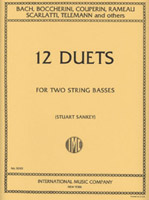
fact that my teacher (at the time) Stuart Sankey, edited a lot of
them. There I could see...."edited by Stuart Sankey"
Geez, I thought...here I go!
 Sankey
was great. We started with Storch-Hrabe. He could
tell the funniest stories (he had made up) about Storch and Hrabe
drinking beers late at night at some pub (100 years before),
thinking of stupid ideas to fluster bass students. I loved all
of it! Sankey
was great. We started with Storch-Hrabe. He could
tell the funniest stories (he had made up) about Storch and Hrabe
drinking beers late at night at some pub (100 years before),
thinking of stupid ideas to fluster bass students. I loved all
of it!
For each page, he would write in some bowings or fingerings that
he wanted me to try. Sometimes we skipped an etude in the book
and would go back to that same missed one a lesson or two later only
because of what I learned in the later one, would make that earlier
one "click" for me. Some teachers like to teach out of certain
books and over the years they learn to utilize every page to their
teaching advantage. In most, but not all cases, etude books
start out easy enough and then get more complex as the book
progresses. As a professional symphony player I've learned
that just playing a one octave scale and doing it perfectly
is hard if you have enough parameters on what it is supposed to
be.
Here's how a good typical practice regime or
schedule might look like for someone in college or soon to be:
- Some kind of Etude book... (Let's use Storch-Hrabe for
example and I would have to learn one etude from that book for
my weekly lesson.) There you will be required to write in
lots of fingerings so that you will be encouraged to use (the
fingerings) that are different and hopefully, a new habit.
- Something from my Symphony literature books. We
almost never did excerpts, but had to learn the whole part!
It would be something like Beethoven's 2nd Symphony (complete.)
Only later did I really spend many hours on audition excerpts.
- Some kind of Solo. The solo...by far, was of
course my favorite part of the lesson and playing sessions.
I remember that I tried to get the symphony "stuff" or the
etudes out of the way early (to be prepared for my lesson) so
that I could really "enjoy" playing my solos. I am sure it
was all good in the sense that know one could fault a young
student for playing his bass all day (no matter what he was
playing!), but truly, it was the solos that got me excited.
Now this was music!
There are lots of really great educational methods, books, DVDs
and even some impressive dealers like us that actually show their
very own videos! So pick out your solo, pick you Etude book
and play!!!
Go back to the bass
method and etude books.
|