French upright bass
 There
are several "schools" or styles of upright bass making and French
double basses have a very special and unique history. Soon after I
got my first carved upright bass (back in 1980), I was intrigued how
my bass luthier could simply look at a bass and quite quickly
announce what country of origin it was from or even the maker that
made the upright. My first upright bass was supposedly French. I
say "supposedly" because now (almost 30 years) I remember some
things on that particular bass that were more Bohemian than French.
More about that later. There
are several "schools" or styles of upright bass making and French
double basses have a very special and unique history. Soon after I
got my first carved upright bass (back in 1980), I was intrigued how
my bass luthier could simply look at a bass and quite quickly
announce what country of origin it was from or even the maker that
made the upright. My first upright bass was supposedly French. I
say "supposedly" because now (almost 30 years) I remember some
things on that particular bass that were more Bohemian than French.
More about that later.
French upright basses
French basses for sure, are the most under
rated (and highly undervalued basses in the world.) While
anyone that has spent even an afternoon searching for information
about upright basses will quickly ascertain that Italian basses are
King! With all the celebrity status that Italian basses enjoy, in
the past 20-30 years, English basses have really almost equaled
their prestige and have caught up to about the same prices.
Italians never really mass produced basses. The English, made
many basses (often some Italian copies) and liked to make the same
models. (See our
English upright basses page for more about them.) The
French, had several things going in their favor. For one, they
had a whole industry of bass making. They made basses for
everyone: students, amateurs, king's courts, and professional
orchestra and ballets as well.
The Mirecourt upright bass
 While
there are some really fine French bass making to this present day,
this page will dedicate more of a historic perspective of French
upright bass. Really, the center of French violin making has
have be Mirecourt, France. In the 18th Century, Mirecourt was
classified as a "department" of France rather than a city. A
region, found far northeast. There are several folk tales
about exactly who or when the first violins were made. One
being that a maker named Tywersus (an Italian none the
less), appeared in Mirecourt and taught a small group of men how to
make violins, and that was the birth of the Mirecourt school!
Only problem is that there was never any mention or instrument ever
made or discovered by such a maker. Mirecourt was churning out
instruments of all sorts in full swing as early as the mid to late
1760's. The real rennaisance period (or golden age period)
would have to be considered the 19th century. Primarily the
dates, when Jean Baptiste Vuillaume lived and died (1798-1875). While
there are some really fine French bass making to this present day,
this page will dedicate more of a historic perspective of French
upright bass. Really, the center of French violin making has
have be Mirecourt, France. In the 18th Century, Mirecourt was
classified as a "department" of France rather than a city. A
region, found far northeast. There are several folk tales
about exactly who or when the first violins were made. One
being that a maker named Tywersus (an Italian none the
less), appeared in Mirecourt and taught a small group of men how to
make violins, and that was the birth of the Mirecourt school!
Only problem is that there was never any mention or instrument ever
made or discovered by such a maker. Mirecourt was churning out
instruments of all sorts in full swing as early as the mid to late
1760's. The real rennaisance period (or golden age period)
would have to be considered the 19th century. Primarily the
dates, when Jean Baptiste Vuillaume lived and died (1798-1875).
Upright basses made in Mirecourt were just normal extensions of
demand for all stringed instruments. Mirecourt was a huge
production, with the whole region making instruments. While it's not
possible to list all of the important bass makers (or firms) that
made French upright basses, here is a short one just for interest
and reference:
French upright bass makers:
-
Jean Baptiste Vuillaume (pronounced: Vwee-ohm')
-
Auguste Bernadel
-
Gustav Bernadel (son of Auguste, started a business with Gand
and actually married his daughter!) henceforth some of the
world's best basses came out of: Gand-Bernadel (and model for
the present day, Wan-Bernadel
upright bass.)
- Charles Nicholas Gand
-
Charles Brugere
-
Leon Mortin
-
Francois Jacque Barbe
-
Paul Claudot
-
Georges Chanot
-
Honore Derazey
-
Joseph Pierre Hel
-
Gabriel Xavier Jacquet
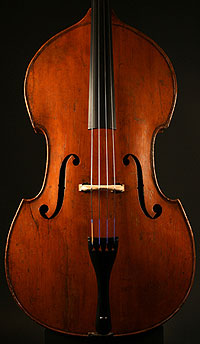 Those
are just a few French upright bass makers. Most interesting though
is the method and business practices of how French upright basses
were produced, marketed and sold. There were entire (huge)
firms that made instruments. One firm is legendary, called
Jérôme-Thibouville-Lamy. They made some good French
basses, but also lots and lots of violins and bows as well.
(they first made woodwind instruments in the 1760's). Also
there were firms that specialized in making upright basses, then
selling them in the white (unfinished) to Parisian shops that then
put their own labels inside and varnished them. Some shops had
special models that they either designed or modified, but were still
made in Mirecourt. Another really famous firm was the
Gand-Bernadel firm. Besides Vuillaume, G&B
made the most well known and sought after basses to this day.
There are many present day makers that still make basses in this
model: (see the Wan-Bernadel upright basses,
Charton and Jean Auray. Another big firm that made great
basses in France towards the end of the 1800's to very early 1900's,
was the Laberte-Humberte firm whom made and sold some very famous
basses to named violin shops/makers in Paris who again, put their
own labels and finished the basses with their own varnish recipes. Those
are just a few French upright bass makers. Most interesting though
is the method and business practices of how French upright basses
were produced, marketed and sold. There were entire (huge)
firms that made instruments. One firm is legendary, called
Jérôme-Thibouville-Lamy. They made some good French
basses, but also lots and lots of violins and bows as well.
(they first made woodwind instruments in the 1760's). Also
there were firms that specialized in making upright basses, then
selling them in the white (unfinished) to Parisian shops that then
put their own labels inside and varnished them. Some shops had
special models that they either designed or modified, but were still
made in Mirecourt. Another really famous firm was the
Gand-Bernadel firm. Besides Vuillaume, G&B
made the most well known and sought after basses to this day.
There are many present day makers that still make basses in this
model: (see the Wan-Bernadel upright basses,
Charton and Jean Auray. Another big firm that made great
basses in France towards the end of the 1800's to very early 1900's,
was the Laberte-Humberte firm whom made and sold some very famous
basses to named violin shops/makers in Paris who again, put their
own labels and finished the basses with their own varnish recipes.
Common characteristics of fine French
upright basses:
-
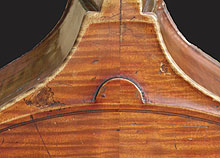 Elegantly
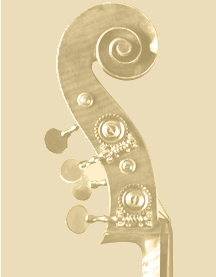
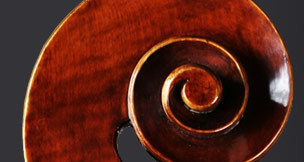
cut scrolls and f-holes (in the Strad pattern) Elegantly
cut scrolls and f-holes (in the Strad pattern)
-
maple two piece backs, sides and neck. The wood found
on a lot of French basses are ravishingly beautiful with heavy
tiger flamed grain particularily on the back, sides and neck.
The tops, (of spruce) have a nice straight grain
-
sloping shoulders
-
violin outline which would include the violin corners and
even sometimes an outline of the violin/cello carved and purfled
into the back which served no purpose other than keep the
symmetry intact.
-
another really interesting style trait on most French upright
basses, is the great fantastic steel and brass tuners. The
Gand-Bernadels and Vuillaume basses had recessed metal tuners
which were reliable (to this day!) and were a huge improvement
over the old ebony "hat-pegged" style used through out the world
until then. The ebony tuners creak, break and do not tune
as finely.
-
more "reasonable" dimensions. Which might be part of
the reason why the French basses and bassists really took off in
the middle 1800's. While one can easily ask: Which came
first, the chicken or the egg...? An easier bass to
play which allowed the player to evolve upwards? Human
nature is the same today: Upright bass players are always,
always trying to make things easier AND sound better at the same
time!
-
Lastly, French upright basses tend to be very focused and
project better. It's a characteristic that comes from the
maple sides and back. There is more power with maple
because the wood itself is stronger and not as soft as poplar or
walnut.
-
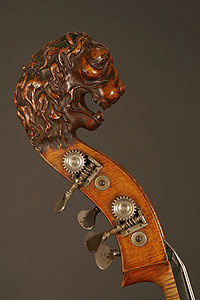
most of the incredible lions head scrolls were done in
France.
-
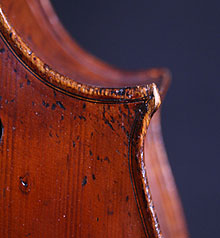
raised edges in front or back
-
sometimes edges of top, back and scroll have a very fine back
paint trim
-
more playable and moderate in size (there are some 7/8
basses, but mostly fuller, 3/4 size that are much easier to play
and get around on
-
On some French basses, tops are thicker
Whether you are looking for a great, French upright bass, or a
new Wan-Bernadel, it's time to
email us a double bass question.
|