German Upright Basses
We've been asked by several of our customers to explain what the
differences are in German upright basses, as compared to other old,
uprights. Germany has a vast history of violin making. (Basses included!)
Just like the violins and cellos, basses have a wide range of quality
and levels. Like the great multitudes of styles of cars made from
Detroit, upright basses in Germany can vary. It's super hard to
compare "German" upright basses with other countries of
origin, when the German bass themselves can be so very diverse.
Let's shed some light on these fascinating basses. (See lots of
nice German upright
basses on our Bass Café pages.)
Let's give some background about German
regions of upright bass making:
Most of the German upright basses most commonly seen around the
world, would be a bass made in Mittenwald, or Markneukirchen in
the late 1880's -1940's. Really, for most of the first half of the
20th century, Germany was the king of upright bass making. They
had the cheaper labor, the great history of violin making tradition
to bank on, and lots and lots of trees!!
There are some common traits that one sees often
on a German upright bass.
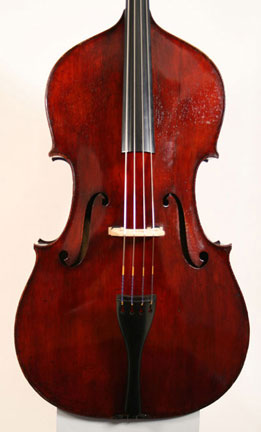 1)
A flat back. Why a flat back? There is likely more than one reason
for this. For one, the flat backed upright bass, is a direct descendant
of the Viola da Gamba. (Which were always made with a flat back).
So the German upright bass as we know today, is quite similar and
is simply a part of Bass evolution. Another important reason that
there are so many flat backed German, upright basses is that quite
simply, it was much cheaper and easier to do so. Carving a big upright
bass back of hard maple wood, is longer, wider, and deeper than
any other instrument. With the flat back, it is simply joined together
in the middle, and cut out into the bass pattern, adding between
2 or 3 back braces and it's done! (see the logic of economics in
a flat backed bass?!!) 1)
A flat back. Why a flat back? There is likely more than one reason
for this. For one, the flat backed upright bass, is a direct descendant
of the Viola da Gamba. (Which were always made with a flat back).
So the German upright bass as we know today, is quite similar and
is simply a part of Bass evolution. Another important reason that
there are so many flat backed German, upright basses is that quite
simply, it was much cheaper and easier to do so. Carving a big upright
bass back of hard maple wood, is longer, wider, and deeper than
any other instrument. With the flat back, it is simply joined together
in the middle, and cut out into the bass pattern, adding between
2 or 3 back braces and it's done! (see the logic of economics in
a flat backed bass?!!)
2) Another trait, but not only pertaining to German basses
is that so many upright basses from Germany are also shaped like
the predecessor instrument,Viol da Gamba. Henceforth, you now know
why basses are called: Gamba shaped. Are you looking for a great
upright German bass? See the Bass Café!
3) Outside linings. While outside linings are not only used
on German basses, they are predominantly found in German upright
basses. Outside linings are the long strips of wood that run outside
a bass' ribs and re-fortify the ribs with the top and back of the
bass. (Every bass has linings on the inside, but the Germans put
them on the other side as well.) They built upright basses to withstand
lots of seasonal changes, and abuse. If you were lucky enough (to
be a German upright bass player) it was a hassle to get the bass
from point A to point B. (Some things never change!) The bass had
to be built knowing that it was going to get banged around and without
this added fortification, would not last!
There are thousands of upright German basses. They come in all shapes
and sizes and stretch across time from the early 1600's up until
this very day. They can come with beautifully carved backs and violin
corners, but these came way later. Today, some of the newer, more
afforable basses (see Wan-Bernadels)
are made with nicer wood, materials and workmanship than a lot of
their "older" brethren. You can email
us here.
| |
 |
 |
|