Student Upright Bass
Upright bass for students 12 and under
will never forget the time I took my son to a music store to buy
a new trombone! All the way there in the car, I was thinking...."all
of the basses we have...why a trombone?" Like any good parent,
we're happy that our kids like music enough to play in the school
band or orchestra. Already being a professional symphony, upright
bass player, I can easily say that "band-jocks" are much
less likely to join a gang! They might have to eat an occasional
goldfish...but that's another story.
I can also remember the tremendous feeling of helplessness when
I stood there in the store, with my son, and triedto pick out a
trombone. First, buying is always going to be the better deal, but
the idea of renting appeased me because I still wasn't too sure
how the it would work out. Most of all, the idea that I just knew
nothing about what made a good trombone, what were the best brands,
or where I was going to get the best price for the best trombone.
That experience taught me to always explain why our own student
upright basses are the best, why we choose these particular basses,
how to take care of them and to explain why they are a good value
for the money.
For a young upright bass student, a good plywood bass is by far,
the best choice to make. They're sturdy, able to withstand lots
of bumps and abuse, and affordable. We always sell our plywood
basses in a kit: Bass, cover, bow and rosin. See our plywood
bass deals!
If the student upright bass player has already been playing
a 1/2 size bass and is ready for the larger size, then by all
means (if able to) buy the the 3/4 sized upright bass. Since your
student has already shown that this is something that they enjoy
and will keep doing, buying is the best way to go for sure. We sell
the very highest level of plywood basses that far exceed the typical
requirements of the American String Teachers Association. Our plywood
basses are not just for students, but there are many professional
players that use our plywood basses everyday. Our prices are the
lowest, but the quality and level of plywood basses are the very
best.
Have a question about
getting a good, upright bass? Email Steve,
at the String Emporium or call him at 800-600-2689
Important points for picking a student upright
bass:
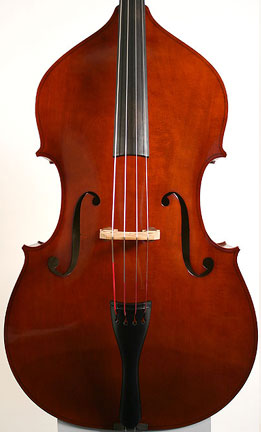 1) First, know what size of student upright bass you
need. 1/4, 1/2 or 3/4. We find that most kids between 10-13
do great with a 1/2 bass. Ask the teachers though! They can size
him up at school and tell you which size will be good. 1) First, know what size of student upright bass you
need. 1/4, 1/2 or 3/4. We find that most kids between 10-13
do great with a 1/2 bass. Ask the teachers though! They can size
him up at school and tell you which size will be good.
2) Nowadays every plywood bass should come with a solid,
ebony fingerboard. The level and accessibility of ebony is so easy
to get now, there is no reason why not to have it. Watch out for
painted or "ebonized" fingerboards. It turns the players fingers
black, and we're not sure what that chemical is anyway!
3) The bridge (that holds up and spaces the strings) should
be a good quality maple (not warped, bending or slanted in any way).
The bridge should have good adjusters that will raise or lower the
strings. You should try adjusting the adjuster wheels making sure
they work and that it's easy to do. You can see a good close-up
of the type of Delrin adjusters we use on our main, Wan-Bernadel
bass page.
4) Make sure that the strings go down low enough on the fingerboard
so that those young hands can easily press the strings down on the
fingerboard without buzzing.
5) Make sure the endpin works and that it has a removable
screw tip (rubber stop) on it. Kids are kids, and will lay the upright
bass down on its side with the sharp pin sticking out. That's ok,
but having that rubber screw tip on the end will make it so much
safer. (You only need to use the sharp pin on wooden (stage floors).
See this type of endpin on our Wan-Bernadel
bass page.
6) A lot of the bows that come with the typical student upright
basses are cheaper fiberglass ones. Student bass bows have gotten
so much cheaper in the past couple of years and getting a real wood
'stick' with good hair is an easy addition.
7) Last, but not least, you should consider getting a bass
wheel. That's right! You can take the end pin rod out (storing it
in the bass cover) and plug a wheel inside the same slot so that
the student can transport the upright bass between drop offs at
rehearsals or concerts. This way, you won't have to park the car
and carry it to the room for him as well!
Which upright bass to get? Rent or purchase?
That's the big question with a student upright bass. On one hand,
renting is less risky, but you end up paying more for it. By less
risky I mean not running out to buy a bass when you you're not sure
if your student is going "take" to the bass or not. My advice is
renting the first 2 or 3 months, if and when you see that the student
enjoying it, and playing, then think about buying one as soon as
you can. You just have to do the math: A typical student
upright player, can play a 1/2 size upright bass for 1-3 years.
So buying a bass, cover and bow for $1,250 can save a lot of money.
If you only keep the bass for one year and you sell it in the local
paper for only $850 you've only "rented" the bass for $400 that
year. There are so many ways to approach this, but one can easily
see the benefits of buying even a 1/2 size bass. Typically the String
Emporium rents the new plywood basses, 1/4, 1/2 and 3/4 for
$50 a month.
If the student upright bass player has already been playing a
1/2 size bass and is ready for the larger size, then by all
means (if able to) buy the the 3/4 sized upright bass. Since your
student has already shown that this is something that they enjoy
and will keep doing, buying is the best way to go for sure. We sell
the very highest level of plywood basses that far exceed the typical
requirements of the American String Teachers Association. Our plywood
basses are not just for students, but there are many professional
players that use our plywood basses everyday. Our prices are the
lowest, but the quality and level of plywood basses are the very
best.
| |
 |
 |
|