Upright double bass humidity
Keeping your upright double bass at the proper humidity level is
very important. Seasonal changes, (whether it be from travel
or changing seasons) can really create havoc on a bass. There
are at least 2 major factors when dealing with humidity (or lack
thereof): The overall level of dryness and sudden changes from wet
to dry or even dry to wet. Keeping your bass in relative parameters
of dryness, helps keep the super highs or low humidity changes less
traumatic. For example, in the winter, with the dry and cold,
do not keep your bass in too wet of an environment. In the winter,
too wet would be in excess of 50% . Keeping the bass at a
higher humidity would normally be fine, but when it goes out into a
much dryer room, the bass can get too much of a "shock" from the
sudden dryness. Stay within some parameters, 40-50% is
perfect. Even 55% would be ok depending where you are going
out into. Some humidity levels in halls or venues (in winter)
can go down into the teens.
Some simple ways to protect the bass in the winter:
1) If you can keep your bass in a special room with a humidifier,
that's great. Just remember not to go too high. Again,
"keeping" it there is fine, but if you keep your bass in a room at
55%, but then take it into a venue that is below 20% for too long
might shock your bass a bit. The idea here is not to keep your
bass in a room in that is too dry, but don't humidify so high that
no matter where you go, it's going to have to change too much.
Keeping a room at 40-50%, ok.
2) Use Dampits. These are the green sponge type
humidifiers that are hung inside of the upright bass f-holes.
A quick note about these: These are my personal favorite.
I use 4 Dampits. Using 4 will help keep me from trying to over
saturate using the normal 2. You don't want to ever drip in
your upright bass! I squeeze the excess water out before
putting them in the bass and when I am not playing, I keep my cover
on the bass. That helps keep the moisture from escaping.
I notice that even when the bass is not super dry, the wood vibrates
so much better. Also, if you live in an area with hard water,
it's good to wipe off the tops of the Dampits that touch against the
bass so that they will not leave a water spot. I've noticed
some new Dampit knockoffs lately that don't hold the same amount of
water and tend to drip too easily. (Only get the
Dampit brand.)
You can buy a Dampit on our bass accessories page here.
3) I also heard of another idea (in the winter) for those living
in small apartments suffering from too dry conditions. Simply
splashing water droplets on the carpet or rug can significantly help
bring up the humidity. This is not practical to have to do every
day. One of my Japanese upright bass player friends has a very
small apartment in Tokyo and when he starts getting static shocks
and the bass gets super dry, he sprinkles water all over the
carpets. (Let's call that one Bass Blessing!) haaa! But it
actually works!
4) Are you in a college or do you have to keep your bass in a
locker? Keep a bucket of water in the corner with a hand towel
clipped on the top edge inside the bucket. This acts as a wick
and will humidify the locker enclosure ( I still like my Dampits
though!)
The best way to monitor humidity and the cheapest, is a cheap
digital gauge one can find at a nearby Walmart. For less than $30,
you can post it near where your bass is normally stored. Don't trust
those silly little color coded cards with the Dampits, they don't
work.
If you live in a region of the country that has super humid
summers and cold, dry winters, you might want to consider having 2
sound posts. Sometimes these posts can really vary in length.
This will keep your happy as it will sound better if the post is not
too short or too long and keep your bass from needless soundpost
cracks. A sign that your post is getting too tight: You can
sometimes see the strings dropping closer to the fingerboard, the
sound post side of the top tilted upwards or the E-string side
f-hole pointed inward a bit. Time to get that post checked then.
When I lived near Chicago, a lot of upright bass players there
had a winter and a summer sound post.
You'll notice that once you become more aware of your surroundings
and the humidity levels, you will be better able to control or
create better conditions for your bass. Just watching
the string height change, or noticing how a bass is responding
(changing) could be enough for you be aware of your post getting too
tight. Any carved upright bass will sound the best if the wood
has some moisture in the wood and will be much less susceptible to
cracks.
Humidity points:
- If you want to buy a room humidifer, look at the smaller
Kenmores. These can be found at Sears, but I just bought
another one one called "Aircare" and it is the same,
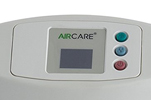 exact machine, but cheaper! I like this one because it has
a nice (big) water tank, is cold air (never get a warm air
type), and this one has a great (reliable) humidity control
button % that you can pre-set. When it gets to your
pre-set level, it shuts off until the room falls below enough to
kick it back on. We use this one in dedicated bass rooms
when the humidity gets too low.
exact machine, but cheaper! I like this one because it has
a nice (big) water tank, is cold air (never get a warm air
type), and this one has a great (reliable) humidity control
button % that you can pre-set. When it gets to your
pre-set level, it shuts off until the room falls below enough to
kick it back on. We use this one in dedicated bass rooms
when the humidity gets too low.
- The easiest, cheapest way to keep your bass healthy is to
use 4 Dampits, with your cover on during the down time (not
playing while you are away or over night).
- Keep an eye on your string height in the winter! If
you see your strings getting really low...that means that the
dryness has gotten into the wood and making your bass contract
and shrink. A little is normal, but don't let it go too
far. (Check that post!)
|